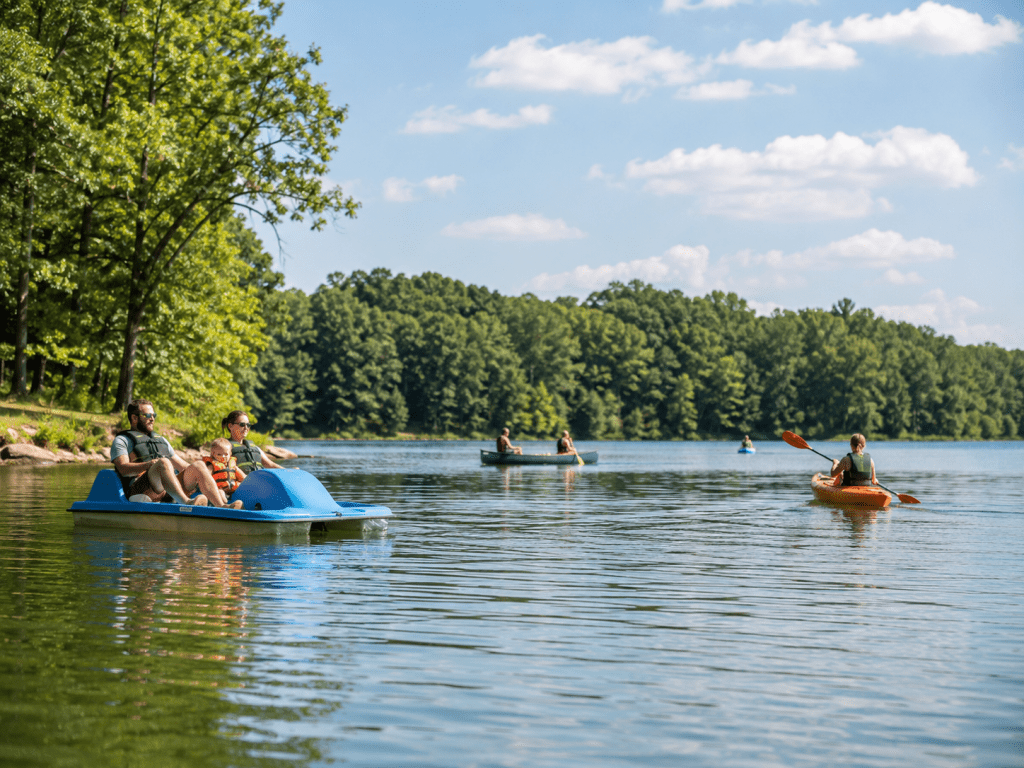
Indianapolis residents do not have to drive to Brown County or Turkey Run to find a real change of scenery.
Fort Harrison State Park sits on the northeast side of the city, near Lawrence, and offers one of the easiest nature escapes in Marion County. It is close enough for a short walk after work, but large enough to support a half-day outing with trails, picnic areas, history and room to slow down.
The Indiana Department of Natural Resources describes Fort Harrison as a 1,700-acre park with walking and jogging trails, picnic sites, fishing access to Fall Creek and two national historic districts.
A Park With Many Seasons
Fort Harrison works because it is not limited to one kind of visit.
In spring, woodland wildflowers make the trails feel newly awake. Summer brings shade, longer walks and the possibility of a canoe trip along Fall Creek. Autumn is one of the park’s strongest seasons, with changing leaves across what DNR calls the last forested corner left in Marion County. Winter brings a sledding hill and cross-country skiing when conditions cooperate.
That year-round usefulness makes the park easy to revisit. The same trail can feel different in April, July, October and January.
Start With Harrison Trace
First-time visitors should consider starting with Harrison Trace Trail.
The trail is listed by DNR as an easy 3.2-mile asphalt route for walkers, bicyclists and joggers. It begins at the Delaware Lake picnic area, passes the lake and follows rolling upland above Fall Creek. Parts of the trail are wheelchair accessible.
For many visitors, Harrison Trace provides the best introduction to the park because it is clear, scenic and manageable. It is also the easiest route to Duck Pond, which can become a natural turnaround point for a shorter visit.
Choose a Trail That Matches the Day
Fort Harrison has more than one mood.
The Fall Creek Trail is listed as a moderate one-mile route to Duck Pond, with options to shorten or vary the walk using cutoff trails. It offers birding, fishing access and opportunities to identify wildflowers and trees.
Camp Creek Trail is a moderate two-mile route with wooded views and bluffs. Lawrence Creek Trail is more difficult at 4.2 miles, winding through upland woods and ravines. Schoen Creek Trail is also listed as difficult, with wetland and prairie grasses.
The point is not to complete every trail. It is to choose the amount of effort that fits the weather, the group and the time available.
Remember the Entrance Fee
Fort Harrison is a state park, so visitors should expect a gate fee unless they have an annual pass.
Indiana DNR lists daily entrance fees at $7 for noncommercial vehicles with Indiana plates and $15 for noncommercial vehicles with out-of-state plates. Pedestrians, bicyclists and horseback riders age 5 and older are listed at $2 per person. Annual entrance passes are also available and are valid from Jan. 1 through Dec. 31 of the year issued.
For frequent park visitors, an annual pass can pay for itself quickly. For occasional visitors, the daily fee is still a relatively low-cost way to spend several hours outdoors.
Do More Than Walk
Hiking is the obvious draw, but it is not the only reason to visit.
The park includes picnic areas, shelters, fishing access and a nature center. The Fort Golf Resort and Conference Center is also located at the property, with an 18-hole course and historic lodging options.
Visitors interested in history can look for the Museum of 20th Century Warfare, which focuses on the military history connected to the former Fort Benjamin Harrison grounds. DNR notes that the former Citizens Military Training Camp is preserved around the park office in what was once known as Camp Glenn.
One current limitation is worth noting: DNR has posted an alert that the saddle barn is temporarily closed while the agency searches for a new concessionaire contractor.
Make It Easy on Yourself
The best Fort Harrison visit is often the simplest one.
Pack water, wear shoes that can handle dirt or pavement, check the weather and pick one trail instead of trying to see the entire park. Families may want to bring snacks and use the picnic areas. Birders should allow extra time near Fall Creek and Duck Pond. Cyclists can use appropriate paved and multi-use routes while watching for walkers.
Because the park is still inside Indianapolis, it is easy to underestimate. That is part of its appeal. Fort Harrison does not require a weekend away or an elaborate itinerary. It offers a practical dose of woods, water and open space close to home.
For a city that often thinks of nature as something outside the loop, Fort Harrison is a useful reminder: one of the area’s best escapes is already inside the city.